A disabled Facebook account is one Facebook has turned off for good. Facebook's own words are "permanently disabled", and you can't use Facebook or Messenger. A suspended account isn't there yet: Facebook gives 180 days to appeal a suspension, a period its help page says varies by region. Facebook disables an account when it decides the account, or activity on it, broke its Community Standards.
Every quote below comes from Facebook's own screens and emails, or from the published rules of Meta, the company behind Facebook. The newest dated screen this guide quotes is from January 2026, and Facebook's and Meta's pages were checked again in November 2026.
Disabled, suspended or restricted: the difference at a glance
Facebook uses three words for three different things. The notice you got tells you which one you're in.
| What you see | What it means | What you can still do |
|---|---|---|
| An email saying "Your Facebook account has been suspended", with 180 days to appeal | The account is switched off, but Facebook hasn't made its final call | Appeal within the 180 days |
| "You submitted an appeal on" a date | Facebook is reviewing the account | Wait, and check the same screen |
| "Your account has been disabled" or "We disabled your account" | Facebook has turned the account off for good | The notice says whether a review is left. If none is, look at the routes outside Facebook |
| Facebook limits what you can post or use for a set number of days | A restriction from strikes, not a ban | Wait it out, or appeal the post behind it |
What a disabled Facebook account means
A disabled Facebook account is switched off for good, and Messenger goes with it. Facebook's disabled screen has the headline "Your account has been disabled" and explains: "You can't use Facebook or Messenger because your account, or activity on it, didn't follow our Community Standards."
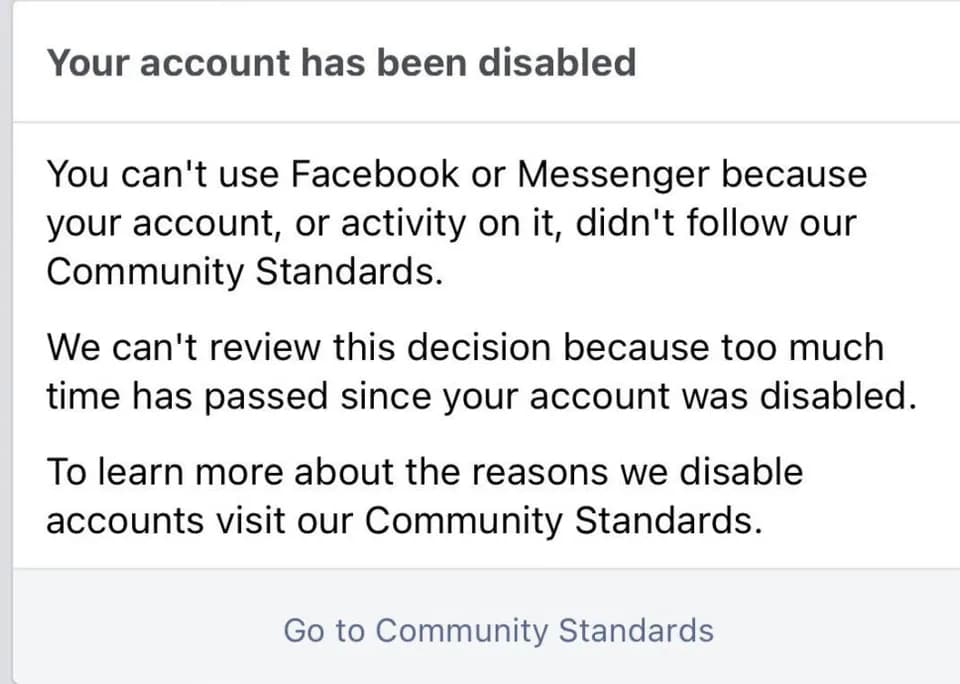
Facebook doesn't soften it. An older Facebook form put it this way: "Your Facebook account has been permanently disabled because it did not follow our Community Guidelines. We cannot review this decision."
How long is a Facebook account disabled or suspended?
A disabled Facebook account stays disabled. Facebook's word is "permanently", and its disabled screen gives no end date. Only a suspension runs on a clock: 180 days to appeal, in Facebook's suspension email. A restriction is shorter still, from 1 to 30 days (more on that below).
Some accounts never get the clock. Facebook's help page says: "We may disable your account without suspending it first, such as in cases of severe or time-sensitive violations."
Can a disabled Facebook account be recovered?
A disabled Facebook account is meant to be final, but Facebook may still offer a review. Meta's page on disabling accounts says: "We also let you know whether you can request another review if you believe we made a mistake." Facebook's screens name two ways that review ends:
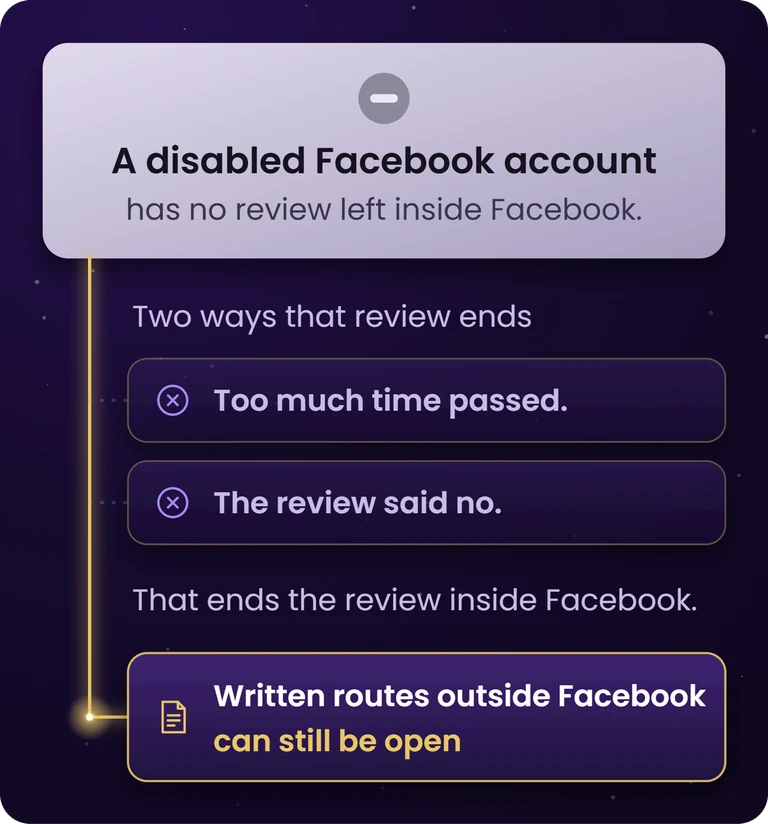
- Too much time passed. The disabled screen says: "We can't review this decision because too much time has passed since your account was disabled."
- The review said no. The review screen warns that after a no, "you won't be able to appeal again." One Facebook notice after a no says: "You cannot request another review of this decision."
Either one ends the review inside Facebook. Neither ends every way to have the decision looked at again. Written routes outside Facebook can still be open, and which ones apply depends on where you live and the kind of account you have. Facebook's own help page, for example, says its decision may be referred to a certified dispute settlement body. Our guide to what to do after a rejected or ignored appeal covers the steps after a no.
Disabled, or locked out?
A locked Facebook account is a different problem from a disabled one. If you can't get in and Facebook shows you no disabled or suspended notice, the cause may not be a ban at all. Someone else may have gotten into the account. Here's how to tell a hacked or locked account from a banned one.
Facebook account suspended: what it means
A suspended Facebook account is switched off, but Facebook hasn't made its final call. One Facebook suspension email has the headline "you have 180 days to take action." It says "Your Facebook account has been suspended" and names the rule broken. In that email, the rule was "account integrity and authentic identity". Then it gives the deadline:
If you think we suspended your account by mistake, you have 180 days to appeal our decision. If you miss this deadline your account will be permanently disabled.
An "Appeal" button sits under that line. Facebook's help page gives the same 180 days and says the time to appeal "varies by region". If you don't appeal in time, or the appeal fails, the help page says "we'll permanently disable your account."
While Facebook reviews an appeal, its screen shows the date you appealed and says "Check back here for the result." It adds: "Your account is not visible to people on Facebook, and you can't use it." On a screen dated January 2026, Facebook says: "It usually takes us about an hour to review your information."
Facebook's appeal screen sets the stakes. If the account follows the Community Standards, "you'll be able to use Facebook again." If it doesn't, the account "will be permanently disabled and you won't be able to appeal again." By Facebook's own words, the review is one try.
Older Facebook forms named 30 days
Not every Facebook notice has said 180 days. An older Facebook form for disabled personal accounts allowed 30: "You can submit more information for 30 days after the deactivation date. After that, the account is permanently disabled and it is no longer possible to request a review."
That form calls the day of the ban the "deactivation date". So Facebook itself has used "deactivation" and "disabled" for the same thing.
Facebook account restricted: strike steps, not a ban
A restricted Facebook account isn't banned, though people often call it "Facebook jail". Facebook limits what you can do with it for a while, and the limits grow with your strikes. A strike can come when Meta removes something you posted. Meta's Transparency Center lists the steps for Facebook accounts:
| Strikes | What Meta does |
|---|---|
| 1 | A warning |
| 2 to 6 | Limits on some features, like posting in groups |
| 7 | A 1-day restriction on creating content |
| 8 | A 3-day restriction on creating content |
| 9 | A 7-day restriction on creating content |
| 10 or more | A 30-day restriction on creating content |
Facebook strikes don't last forever. Meta's rules say:
- A strike expires after one year.
- Most posts older than 90 days earn no strike. For the most severe rules, the limit is 4 years.
- Several posts removed at once may count as one strike.
- A content appeal that succeeds removes the strike and the restriction, "so that it won't count against you in the future."
Meta's strike steps have an end. If the strikes keep coming, Meta's page on disabling accounts says "we may remove your account".
The Oversight Board hears appeals about posts. On 4 June 2026 the Board ruled on a permanently disabled account for the first time: an Instagram account Meta invited it to review, as a pilot. It upheld the ban, and says it "does not yet have a mandate to accept cases on accounts."
Meta counts strikes on Facebook and Instagram alike. If your Instagram account was hit too, here's what Instagram's suspended and disabled screens mean.
Why is my Facebook account disabled?
Facebook disables an account when it decides the account, or activity on it, broke its Community Standards. That is the line on Facebook's own disabled screen. Meta's published rules name the patterns behind it:
- Breaking the rules again and again. Removed posts add strikes, and the steps above end with the account at risk.
- One severe violation. Under Facebook's most serious rules, a single violation can disable the account.
- Getting around an earlier ban. Meta works to disable "accounts created to get around our restrictions" as soon as it finds them.
- Identity. Meta works to disable accounts that misrepresent who is behind them as soon as it finds them. One Facebook suspension email names the rule "account integrity and authentic identity".
- What you engage with. Engaging with content that breaks the rules, or being a member of groups Meta removed, can also lead to action on your account.
Why did Facebook disable or suspend my account for no reason?
Facebook does give a reason, but it can be a single line naming a rule. Three things can make it feel like no reason at all:
- Nobody had to report you. Meta's Transparency Center says: "Our technology proactively detects and removes the vast majority of violating content before anyone reports it."
- There may be no post to point to. Facebook's notices blame "your account, or activity on it", so the cause can be how the account was used, not one post.
- The rule named is broad. "Account integrity and authentic identity" doesn't say which login, post or other account set it off.
Facebook's disabled screen sends you to the rules for more: "To learn more about the reasons we disable accounts visit our Community Standards." Read the rule your notice names before you do anything else.
What to do next with a disabled or suspended Facebook account
Each Facebook notice leaves you different options. Read yours first.
- The suspension email, with 180 days. That's your time to appeal. A no from Facebook's review ends the appeals inside Facebook, so the one review matters. The guide on what a ban appeal letter should say covers what to say where Facebook gives you room to write.
- "You submitted an appeal on" a date. The screen says "Check back here for the result." The account stays hidden until Facebook answers.
- "Your account has been disabled". Check whether the notice still offers a review. If it doesn't, look at the written routes for where you live.
- A restriction. The account is still yours. Wait out the days, or appeal the removed post behind the strike.
Steps that keep your options open
- Screenshot every Facebook notice. Keep the screens and emails, with the dates and the rule Facebook named.
- Save the reference number if you live in the EU. In Facebook's decision message, "Information for people in the EU" and then "Get information" show a number that starts with FB-. An outside dispute body asks for it, and the page that makes a new one sits behind Facebook's login.
- Take a copy of your information if Facebook offers it. One Facebook notice after a failed review carries a "Download Your Information" button.
- Don't open a new account to get around the ban. Meta works to disable accounts made to get around a ban as soon as it finds them.
- Be wary of strangers. Don't trust anyone who messages you offering to get the account back, and never share your password or a login code. People report that Facebook runs no support phone line, so treat any number that claims to be Facebook support with suspicion.
- Confirm your identity only inside Facebook. Facebook's own screen can ask for a video selfie ("Confirm your identity", then "Start video selfie"), and an older Facebook form asked for an ID document. Do these inside Facebook, never for someone who messages you.
For any platform, Owlibi's free guide on what to do when an account gets banned has a printable checklist of what to gather before you appeal.
Owlibi never messages anyone first, and never asks for a password, a code or ID.
If your Facebook account is disabled or suspended, Owlibi prepares the letters for every route your case allows, as part of our appeal service for disabled Facebook accounts. You send each letter yourself. We don't guarantee unbans.
Not sure what's left? Tell us in the free case check. We answer by email within 24 hours with whether we take your case and what it costs.

Written by
Owlibi
Owlibi is a specialist account appeal service preparing personalised appeals, escalation letters and step-by-step guidance beyond the standard appeal process.
About Owlibi